Showing posts with label udaloy i. Show all posts

Monday, October 10, 2016

"Admiral Kuznetsov" & Friends to Deploy Soon

SU-33 Flanker and MIG-29K Fulcrum on board "Admiral Kuznetsov" -- August 2016

It now appears certain that the Russian Navy's sole aircraft carrier, "Admiral Kuznetsov", along with the nuclear-powered cruiser "Petr Velikiy" and destroyer "Severomorsk", are preparing to deploy within the next week.

"Petr Velikiy" -- May 2016

According to social media, "Petr Velikiy" was scheduled to transfer to a mooring position near Severomorsk today and depart from there on October 15 for a six- to eight-month deployment.

"Admiral Kuznetsov" performing final preparations -- October 8, 2016

"Admiral Kuznetsov" will arrive at a similar mooring position near Severomorsk on October 11. Interfax, citing an anonymous source, earlier reported the aircraft carrier would depart on October 15-20.

"Severomorsk" at 35th Shipyard -- July 8, 2016

"Severomorsk" is also scheduled to depart on October 15, based on social media.

Auxiliary support for the deployment will likely include salvage tug "Nikolay Chiker" and oiler "Sergey Osipov". "Nikolay Chiker" is currently moored near Severomorsk Naval Base. "Sergey Osipov" was noted underway near Severomorsk Naval Base on October 8.

KA-52 Hokum on board "Admiral Kuznetsov" -- August 29, 2016

The aircraft carrier is expected to deploy with a mixed inventory of KA-27/KA-29 Helix and KA-52 Hokum helicopters, as well as SU-33 Flanker and MIG-29K Fulcrum fighters.

Repairs of "Admiral Kuznetsov" began last spring, and it appeared they would continue until the end of this year; however, the repairs were completed earlier than scheduled. Following a number of underway combat drills and carrier flight operations, "Admiral Kuznetsov" returned to Rosta for final preparations before it transfers to its Severomorsk mooring position this week.

"Admiral Kuznetsov" & Friends to Deploy Soon

SU-33 Flanker and MIG-29K Fulcrum on board "Admiral Kuznetsov" -- August 2016

It now appears certain that the Russian Navy's sole aircraft carrier, "Admiral Kuznetsov", along with the nuclear-powered cruiser "Petr Velikiy" and destroyer "Severomorsk", are preparing to deploy within the next week.

"Petr Velikiy" -- May 2016

According to social media, "Petr Velikiy" will transfer to a mooring position near Severomorsk on October 9 and depart from there on October 15 for a six- to eight-month deployment.

"Admiral Kuznetsov" performing final preparations -- October 8, 2016

"Admiral Kuznetsov" will arrive at a similar mooring position near Severomorsk on October 11. Interfax, citing an anonymous source, earlier reported the aircraft carrier would depart on October 15-20.

"Severomorsk" at 35th Shipyard -- July 8, 2016

"Severomorsk" is also scheduled to depart on October 15, based on social media.

Auxiliary support for the deployment will likely include salvage tug "Nikolay Chiker" and oiler "Sergey Osipov". "Nikolay Chiker" is currently moored near Severomorsk Naval Base. "Sergey Osipov" was noted underway near Severomorsk Naval Base on October 8.

KA-52 Hokum on board "Admiral Kuznetsov" -- August 29, 2016

The aircraft carrier is expected to deploy with a mixed inventory of KA-27/KA-29 Helix and KA-52 Hokum helicopters, as well as SU-33 Flanker and MIG-29K Fulcrum fighters.

Repairs of "Admiral Kuznetsov" began last spring, and it appeared they would continue until the end of this year; however, the repairs were completed earlier than scheduled. Following a number of underway combat drills and carrier flight operations, "Admiral Kuznetsov" returned to Rosta for final preparations before it transfers to its Severomorsk mooring position this week.

Sunday, February 7, 2016

Russian Navy Exercise in Eastern Mediterranean Sea

Flight ban (yellow) and flight route restrictions (red) for Russian Navy combat drills -- January 8-11, 2016

In late January, flight bans and route restrictions were announced for a Russian Navy exercise:

A0037/16 - RUSSIAN NAVY EXERCISE (ROCKET TEST FIRINGS) WILL TAKE PLACE IN AREA BOUNDED BY:
344400N0345800E
351300N0345800E
351300N0353300E
344400N0353300E
THE AREA INCLUDES BUFFER ZONE. SFC - FL660, 0500-1500, 08 FEB 05:00 2016 UNTIL 11 FEB 15:00 2016.


A0039/16 - DUE TO RUSSIAN NAVY EXERCISE AS REFERED IN NOTAM A0037/16 THE FOLLOWING AIRWAYS WILL BE CLOSED:
W/UW17 (BALMA-NIKAS)
R/UR78, M/UM978 (ALSUS-NIKAS)
BTN SFC-FL660. 0500-1500, 08 FEB 05:00 2016 UNTIL 11 FEB 15:00 2016.


The flight ban and flight route restrictions are identical to those used before by the Russian Navy.

While there has been no official statement by military public affairs representatives about the exercise, there are two naval combatants operating in the eastern Mediterranean Sea that could utilize the area: Slava-class cruiser "Varyag" (Pacific Fleet) and Udaloy I-class destroyer "Vitse-Admiral Kulakov" (Northern Fleet). Last month, the destroyer conducted anti-air warfare training that included simulated surface-to-air missile and gunnery drills.

Saturday, June 13, 2015

Where in the World is "Admiral Panteleyev"?

Udaloy I destroyer "Admiral Panteleyev" - undated

On February 4, a Russian Navy Pacific Fleet surface action group led by Udaloy I-class destroyer "Admiral Panteleyev" departed Vladivostok for what was supposed to be a three-month deployment. That deployment has now stretched into its fifth month, and no one knows for sure when it will return to its home port.

The group, which also includes two auxiliary vessels (Dubna tanker "Pechenga" and Goryn rescue tug "SB-522"), was reported to be conducting training in the South China Sea a week later. The group was supposed to arrive in Cam Ranh Bay, Vietnam, but that port call never happened due to changes in operational plans, according to an anonymous source.

Following a short port call in Sattahip, Thailand, in early March, a six-day port call in Langkawa, Malaysia, in mid-March, and a brief port call in Colombo, Sri Lanka, in late march, "Admiral Panteleyev" and its support vessels headed into the Indian Ocean. The official story ends when the ships departed Colombo on April 1.

The reason the Russian MOD has not released any new information on the group's whereabouts may be connected to the mission it is currently performing. On April 12, the MOD announced that Black Sea Fleet Vishnya intelligence collection ship SSV-201 "Priazovye" was involved in evacuating combat zone refuges from Yemen to Djibouti, even though the spy ship's participation began at least two weeks earlier. If the "Admiral Panteleyev" group were some how involved in an ongoing humanitary mission, one might expect the MOD to publicly tout the destroyer's efforts. But there has only been silence.

Social media, on the other hand, has provided a few clues. In early May, the destroyer was reportedly anchored near Africa, but not in a port. In early June, "Pechenga" made a port call in Salalah, Oman, to take on supplies before returning to the destroyer's location. It seems the destroyer hadn't moved from the same anchorage at which it arrived in May. While the exact whereabouts remain a mystery, according to one source, the ship is supposed to conduct a port call - somewhere - in the coming days. As for when it might return to Vladivostok, one source indicated mid-August as a likely time frame.

What is "Admiral Panteleyev" doing that is so secret?

Wednesday, February 4, 2015

Salyut Beats MOD in “Vitse-Admiral Kulakov” Case

On April 12, 2002, the Russian MOD (Naval Directorate of the Chief of Shipbuilding, Weapons, and Weapons Maintenance) signed a contract (#713/03/28/KN/0321-02) with Salyut Scientific Production Enterprise under which Salyut was to complete experimental design work “Rybets”. On September 25, 2010, the sides signed a Supplementary Agreement (#704/28/3/REV/D018/0115-10) which further defined certain stages and sub-stages of the state contract, to include:

Stage 9 – confirmation of the working design documentation in order to set up serial production of the 5N-30N; cost of this stage: RUB 1,672,654; work commencement: November 6, 2010; work conclusion: November 25, 2010

Stage 16 – confirmation of the working design documentation in order to set up serial production of the UN-30112; cost of this stage: RUB 1,670,858; work commencement: November 6, 2010; work conclusion: November 25, 2010

Stage 17 – confirmation of the working design documentation in order to set up serial production of the 511-3011; cost of this stage: RUB 1,170,858; work commencement: November 6, 2010; work conclusion: November 25, 2010

Prototypes of the 5P-30N (Fregat-N) and 5P-30N2 (Fregat-N2) radars, as well as the 5P-30P radar data processing system, were originally scheduled to be tested on Udaloy I-class destroyer “Vitse-Admiral Kulakov” in March-April 2010; however, due to an unanticipated issue with the ship’s hull that required dock repairs, the testing was delayed until November 25, 2010. Initial testing was completed on October 15, 2010, and the prototypes were handed over to the MOD for state testing on the same date. However, according to RF Navy Commander-in-Chief Decision #721/ОНК/5538  - “Preparing Project 1155 Large ASW Ship “Vitse-Admiral Kulakov” to Join the Permanent Ready Forces and Transfer to Its Homeport” (dated September 22, 2010), the destroyer was accepted before state testing and acceptance of the 5P-30N, 5P-30N2, and 5P-30P could be completed.

Both sides signed a joint decision on January 31, 2011, that reiterated that initial testing of the prototype equipment had been completed, but due to the destroyer’s transfer from the Baltic Fleet to the Northern Fleet, state testing could not be completed earlier than 2011. According to the decision, state testing would be finished during the second quarter of 2011, and all actions related to preparing the prototypes for serial production would be completed in October 2011. Based on Northern Fleet leadership input, a decision was made by the state acceptance committee to conduct state testing of the prototype equipment by September 30, 2011.

The end date was further pushed back until December 1, 2011, due to the requirement for the destroyer to undergo a 41-day shipyard repair period between October 1 and November 10. The at-sea test date was set for November 16. After several more delays, the destroyer finally got underway for testing – but without any industry personnel on board, thus preventing the completion of state testing. Salyut complained to the Northern Fleet commander, who in turn ordered the ship back to sea on December 6 to perform the state testing. Several fleet aircraft (IL-20 Coot A, IL-38 May, and KA-27 Helix) provided support for that day’s testing. Based on the first day's results, everyone agreed the prototype equipment was ready for a live missile launch against a P-120RM target missile the next day. However, on December 7, the ship’s 3R-95/Kinzhal (SA-N-9/Gauntlet) surface-to-air missile suffered a malfunction that the crew could not fix. Since, without the SA-N-9, the ship would be unable to protect itself in the event the P-120RM target missile veered off course, a decision was made to suspend state testing and return to port. The ship returned to port on December 8, and fleet personnel began removing the ship’s weapons on December 9 in advance of placing the destroyer in a dry dock. The Northern Fleet agreed that the next time the ship would be available to perform state testing of the prototype equipment would be February 2012.

On November 27, 2013, the MOD filed a suit against Salyut for failure to full its contractual obligations by the stated deadline. In its suit, the MOD sought RUB 1,561,589 in fines for non-fulfillment of the contract.

On February 20, 2014, the Arbitration Court of Moscow issued a ruling in the case (#A40-169577/2013) in favor of Salyut, stating that Salyut could not be blamed for the MOD’s inability to provide the proper equipment (i.e., operable destroyer with operable SA-N-9) within the stated time frame.

Not satisfied with the verdict, the MOD filed an appeal with the 9th Arbitration Appellate Court on April 29, 2014. The court upheld the lower court’s decision on June 11.

On August 14, the MOD filed a final appeal with the Arbitration Court of the Moscow District, which similarly dismissed the case in line with the two previous decisions.

Wednesday, November 5, 2014

Putin Bringing Big Guns to G20 Summit

Russian Federation President Vladimir Vladimirovich Putin
(Image credit: TASS)

During next week's Group of 20 Summit in Brisbane, Australia, Russian President Vladimir Putin will have something in his back pocket - something few other world leaders (if any) will have: his own naval task group.

In September, it was announced that, despite calls to prevent Putin from attending the G20 Leaders' Summit, the Russian president was expected to participate.

On October 23, a Russian Pacific Fleet surface task group departed Vladivostok for "combat service in southern areas of the Pacific Ocean," according to a naval spokesman. The group consists of Slava-class cruiser "Varyag", Udaloy I-class destroyer "Marshal Shaposhnikov", Baklazhan-class salvage and rescue tug "Fotiy Krylov", and Chilikin-class replenishment oiler "Boris Butoma".

While no press reporting to date has indicated exactly where in the south Pacific these ships will operate, leave it to social media to spill the details. In early November, some family members or loved ones of sailors on a couple of the task group's ships specifically indicated Australia as a future operating area. One source concerned about loosing cellphone contact with her loved one wrote, "There are no shorelines anywhere along the way to Sydney!" Another source reported that the ships would travel to Australia first before commencing a return leg towards Vladivostok.

Russian ships traveling to faraway exotic ports to support presidential visits is not unusual. Udaloy II-class destroyer "Admiral Chabanenko" supported President Dmitriy Medvedev's visit to Venezuela in November 2008, and "Varyag" called in San Francisco in June 2010 to support President Medvedev's visit to California. Even closer to home, Slava-class cruiser "Moskva" was in Sochi this August to support meetings between President Putin and Egyptian President Abdel Fattah el-Sisi.

What makes this deployment strange is that no one in Canberra has mentioned any port calls by the "Varyag" task group. And if there are no scheduled port calls, why is the task group heading in that direction? How exactly does demonstrating the flag off the coast of Australia support Putin's G20 Summit plans?

Sunday, September 21, 2014

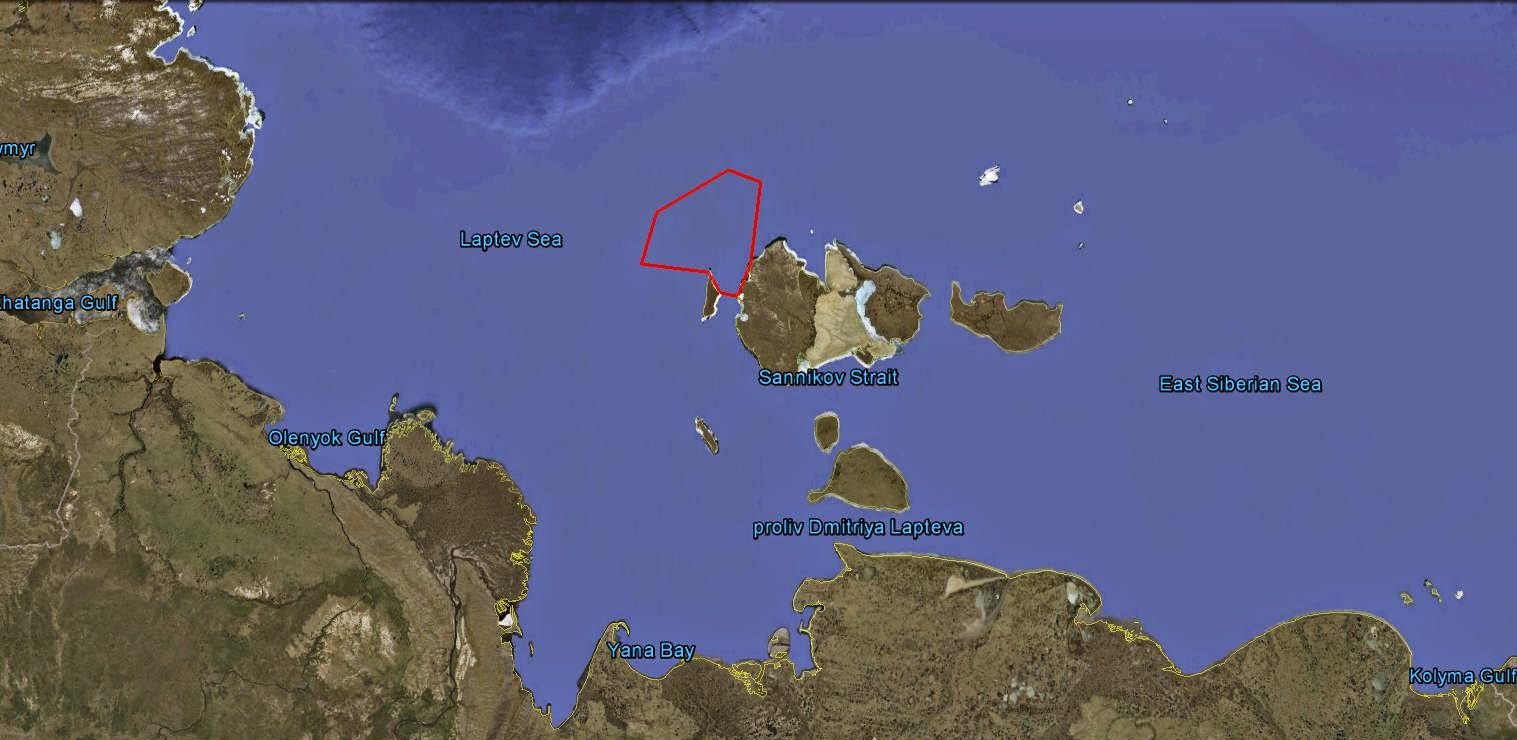
Update: Impending Missile Launch from Kotelnyy Island?

Gunnery/missile area closures near Kotelnyy Island - September 15-25, 2014 (Map courtesy of Google Earth)
Russia has reissued and extended an area closure near Kotelnyy Island:
ARCTIC.
LAPTEV SEA.
MISSILES. GUNNERY.
1. HAZARDOUS OPERATIONS 2200Z TO 1800Z
COMMENCING DAILY 21 THRU 25 SEP IN AREA BOUND BY
75-53.4N 132-39.0E, 76-28.2N 133-08.0E,
76-50.8N 135-00.0E, 76-58.5N 136-26.1E,
75-57.7N 137-33.5E, 75-35.5N 137-00.0E,
75-37.5N 136-13.5E, 75-50.7N 135-41.0E.
2. CANCEL THIS MSG 261900Z SEP 14.
The new area closure (depicted in yellow above) is slightly different in shape when compared to the earlier closure (depicted in red) that remains in effect until tomorrow.

Moreover, the new area closure's effective dates (September 21-25) coincide nicely with the Vostok-2014 strategic command-staff exercise that kicked off on September 19 and runs through September 25. Whether or not this is related to the exercise, a missile launch from this Arctic island certainly will be linked by the media to the new "North" Joint Strategic Command. According to an ITAR-TASS unnamed "Ministry of Defense source," the new command will stand-up on/before December 1, 2014.

Wednesday, September 17, 2014

Impending Missile Launch from Kotelnyy Island?

Gunnery/missile area closure near Kotelnyy Island - September 15-21, 2014 (Map courtesy of Google Earth)
An interesting area closure has been declared west of Kotelnyy Island, where a Russian Navy Northern Fleet task group arrived this past weekend:
ARCTIC.
LAPTEV SEA.
MISSILES. GUNNERY.
1. HAZARDOUS OPERATIONS 0001Z TO 1600Z
DAILY 15 THRU 18 SEP IN AREA BOUND BY:
75-53.4N 132-39.0E, 76-28.2N 133-08.0E,
76-58.5N 136-26.1E, 76-50.8N 138-00.0E,
75-57.7N 137-33.5E, 75-35.5N 137-00.0E,
75-37.5N 136-13.5E, 75-50.7N 135-41.0E.
2. CANCEL THIS MSG 181700Z SEP 14.
ARCTIC.
LAPTEV SEA.
MISSILES. GUNNERY.
1. HAZARDOUS OPERATIONS 2200Z TO 1800Z
COMMENCING DAILY 18 THRU 21 SEP IN AREA BOUND BY:
75-53.4N 132-39.0E, 76-28.2N 133-08.0E,
76-58.5N 136-26.1E, 76-50.8N 138-00.0E,
75-57.7N 137-33.5E, 75-35.5N 137-00.0E,
75-37.5N 136-13.5E, 75-50.7N 135-41.0E.
2. CANCEL THIS MSG 221900Z SEP 14.
The area closure went into effect on September 15 and will expire on September 21. The warning messages indicated missiles would be launched during the closure times. Given that the closure touches the coastline, it is reasonable to believe a land-based coastal defense cruise missile (CDCM) will be fired. The Northern Fleet task group is comprised of six ships, only one of which is armed with any type of missile: Udaloy I-class destroyer "Admiral Levchenko" with its SA-N-9 Gauntlet AAW and SS-N-14 Silex ASW missile systems. It's highly unlikely the area closure was declared solely for these systems.

A late August Russian MOD press release reported that "coastal missile...units" were part of the "Admiral Levchenko" task group, but it didn't state whether the task group's two landing ships were ferrying the mobile CDCMs or if they were being ferried to the island by other means. At least five commercial vessels have made or soon will make trips to Kotelnyy Island this summer: "Aleksandr Suvorov", "Arkadiy Chernyshev", "Kapitan Borodkin", "Valeriy Vasilyev", and "Yuriy Arshenevskiy". The latter unit ferried unspecified military hardware to the island earlier this month.

At its farthest points (from Mys Durnoy (Zarya Strait) in the south to the northernmost coordinate), the area closure is just over 83nm in length. While it is unknown exactly which mobile CDCM systems may have been ferried to Kotelnyy Island, the length of this area closure could support launches by either the SSC-1B Sepal (approx. range 250nm) or SSC-3 Styx (approx. range 45nm). Given the Russians may place a target near the middle of the area or even closer to shore, it seems like a waste to launch the longer-range SSC-1B only 40 or so nautical miles. That distance, however, would be perfect for the near maximum range of the SSC-3.

A missile shot from the island will certainly be covered by both military and commercial media sources, at which we point we should be able to solve this riddle.

Tuesday, September 2, 2014

Is Mediterranean Sea Dangerous for Russian Navy Destroyers?

The Russian Navy Northern Fleet's Udaloy-class destroyer "Vitse-Admiral Kulakov" is currently undergoing repairs in Sevastopol following a collision with an unknown tanker in the Mediterranean Sea last month, according to internet chatter. This follows two other incidents with Udaloy destroyers having to enter the Black Sea for repairs during their Mediterranean Sea deployments. In May-June 2013, the Northern Fleet's Udaloy-class destroyer "Admiral Levchenko" underwent repairs, to include work on its bow-mounted sonar. And between June and September 2013, the Pacific Fleet's Udaloy-class destroyer "Admiral Panteleyev" underwent some type of repairs in Novorossiysk. It is noteworthy that no other major combatant from the Mediterranean Task Force has had to enter the Black Sea for repairs.

Naval officials' claims that these were "routine" repairs are dishonest. Ships already complete lengthy shipyard periods before departing on lengthy deployments. Therefore, there should be nothing "routine" about theses destroyers having to break from the task group and head for Sevastopol or Novorossiysk.

The impact? The Black Sea Fleet's Slava-class cruiser "Moskva" now has to spend "more than two months" in the Mediterranean Sea, according to an unnamed Navy Main Staff source. According to one internet source, the cruiser will depart on 2 or 3 September for a deployment that will last "2-3 months at a minimum."

Wednesday, August 27, 2014

Russia's Secret Naval Exercise

Depictions of area closures [Courtesy: Google Earth; Data: GEBCO, NGA, NOAA, SIO, U.S. Navy]

Russian Navy public affairs officers must be on extended summer vacations, because they haven't been churning out press releases on a major exercise off the Kamchatka Peninsula (Russian Far East) set to commence as early as this Thursday. I mean, with all these recent reports of ghost submarines appearing off Russian coastlines, someone's got to be in the office -- those intelligence leaks didn't just happen by themselves. [More on the ghost submarines in a later blog entry.]

Two area closures have been announced for August 28 through September 5:
  • HYDROPAC 2470/14 (larger area closure)

    KAMCHATKA-SOUTHEAST COAST.
    MISSILES.
    1. HAZARDOUS OPERATIONS 2000Z TO 0800Z COMMENCING
    DAILY 28, 29 AUG, 04 AND 05 SEP
    IN AREA BOUND BY
    50-06-18N 161-38-54E, 50-34-48N 160-14-30E,
    51-23-54N 159-44-24E, 52-16-24N 158-31-30E,
    53-05-48N 160-01-48E, 51-28-54N 163-34-00E,
    51-08-18N 163-18-30E, 50-16-12N 162-11-00E.
    2. CANCEL THIS MSG 060900Z SEP 14.//

    Authority: NAVAREA XIII 77/14 230915Z AUG 14.
    Cancel: 06090000 Sep 14
  • HYDROPAC 2482/14 (smaller area closure)

    WESTERN NORTH PACIFIC.
    KAMCHATKA-SOUTHEAST COAST.
    GUNNERY.
    1. GUNNERY EXERCISES 1900Z TO 0800Z COMMENCING
    DAILY 30 AUG THRU 03 SEP IN AREA BETWEEN
    52-30N 52-41N AND 159-44E 160-07E.
    2. CANCEL THIS MSG 040900Z SEP 14.//

    Authority: NAVAREA XIII 79/14 250916Z AUG 14.
    Cancel: 04090000 Sep 14
So, what's happening here? According to internet chatter, the following surface combatants recently transited (or soon might) from the Pacific Fleet's main naval base in Vladivostok to ports on the Kamchatka Peninsula (arriving on August 25):
  • Slava-class cruiser "Varyag"
  • Sovremennyy-class destroyer "Bystryy" (may have engine problems)
  • Udaloy I-class destroyers "Admiral Panteleyev", "Admiral Vinogradov", and "Marshal Shaposhnikov" (the latter will join up in September)
  • Grisha III-class light frigate "Kholmsk"
  • Grisha V-class light frigate "Sovetskaya Gavan"

The large area closure is well suited for the SS-N-12/Sandbox and SS-N-22/Sunburn anti-ship cruise missiles fired by the Slava and Sovremennyy, respectively.

Is this the start of this year's premier military exercise - Vostok-2014? Previous mentions of Vostok-2014 only indicated that the exercise would occur in September, and most recently, in mid-September. And one netizen wrote, "[Vostok-2014] will last the entire month of September." Military public affairs officers oddly have not provided more definitive dates. If this week's events aren't part of Vostok-2014, then they certainly are meant to prepare ships' crews for it.

Also, according to internet chatter, many of these combatant ships will be away from Vladivostok for up to one month, leaving them plenty of time to conduct additional combat drills. This tidbit of information could confirm the "visible" (to the media) part of Vostok-2014 exercise will occur mid- or late September. We'll need to track President Putin's and Minister of Defense Shoygu's travel schedules over the next few weeks.

As for non-naval participation in Vostok-2014, internet chatter indicates elements of the 38th Separate Motorized-Rifle Brigade have deployed (or soon will) to the Kamchatka Peninsula. About a dozen or so Su-27SM and Su-35 fighters (from Dzemgi and/or Uglovaya) have been deployed there since at least mid-August.

Furthermore, according to internet chatter and somewhat confirmed by this company-press-release-turned-news-article, "Varyag" will continue on an extended deployment to the Indian Ocean following the Vostok-2014 exercise. The deployment has been described by one source as lasting up to six months -- unsure if that six-month counter started when "Varyag" left Vladivostok, or if it will start after Vostok-2014 is over. In either case, a sailor on board the cruiser reported recently that he is going on a deployment that will last until February 2015 during which "Varyag" will make port calls in Indonesia, Singapore, (South?) Korea, and two other unnamed ports.

Monday, September 16, 2013

UPDATE: Is Russia's Surface Fleet Being Stretched to the Limit?

In a brief update to my previous blog entry:

  • Admiral Panteleyev finally returned to the Mediterranean Sea last week following possible repairs of unknown equipment that broke down some time in July.
  • Russia had to use a Tarantul III-class patrol combatant to escort another "Syrian Express" landing ship to the Mediterranean Sea and back in mid-August.
  • Rumors abound that Udaloy I-class destroyer Vitse-Admiral Kulakov suffered some type of propulsion problem in early-August shortly after its Havana, Cuba, port call. The ship failed to meet its previously scheduled port calls despite Moscow's insistence that the destroyer has been tagging along with Slava-class cruiser Moskva the entire time. Instead of bringing the ship home early, naval officials apparently decided it was better to keep the destroyer out of sight and tow it back to the Barents Sea on/about its scheduled return date. Given that no immediate tow service was required, it's possible the destroyer is as least partially operational, which means it has enough power to limp into port while TV cameras are rolling. As soon as the sailors hit the shore, we'll learn more... According to some internet chatter, Sorum-class oceangoing tug MB-304 may be towing the destroyer northeast in the Atlantic Ocean, and both units may rendezvous with Baklazhan-class salvage and rescue tug Nikolay Chiker, which has been hanging around the United Kingdom for several weeks -- most recently southeast of Cork, Ireland.

Saturday, March 31, 2012

Smetlivyy - Russia's "Clever" Destroyer

When the Russian Navy’s last remaining Kashin-class destroyer, Smetlivyy, departs Sevastopol on April 1, how will military officials characterize the purpose of the ship’s 45-day deployment?  Combat training, of course.  But what will the true purpose be?

Timeline
- Early-January:  Russian Northern Fleet combatant ships conduct two-day port call in Tartus, Syria, in early-January.  Ships conduct a typical working port call:  moor, take on supplies, leave.  Nothing more, nothing less.  But neither the Russian nor Syrian press machines could forgo mentioning the tour given to high-level Syrian officials aboard the Russian Kuznetsov-class aircraft carrier Admiral Flota Sovetskogo Soyuza N.G. Kuznetsov.  Moscow downplayed the visit, while Damascus proclaimed the visit was a sign of deep military cooperation between the two nations and support for the al-Assad regime.

- Early-February:  Internet chatter indicates the Russian Black Sea Fleet is preparing to send Ropucha II-class landing ship Azov to Syria, possibly to evacuate non-combatants from the crisis-plagued nation.  The ship never departed the Black Sea and, instead, has been involved in annual certifications, to include taking part in a command-post exercise this past week.

- Mid-February:  Internet chatter indicates Smetlivyy is preparing to deploy to the Mediterranean.

- Early-March:  Internet chatter indicates some Black Sea Fleet naval infantry personnel will depart in mid-March to participate in two month-long counter-terrorism training in Italy.  The personnel will return to Russia aboard Smetlivyy.  Later, the training in Italy later is postponed or canceled.

- Mid-March:  Internet chatter indicates Smetlivyy begins weapons and stores onloads on/about March 16 in preparation for subsequent at-sea certifications and deployment.  Smetlivyy departs Sevastopol on March 19 en route to Novorossiysk to complete its annual combat certifications.

- Late-March:  Internet chatter indicates Smetlivyy will depart Sevastopol on April 1 for its nearly two-month deployment.

So, What’s Up?
Were Moscow truly concerned about openly supporting the Syrian regime, one would expect much more military cooperation, to include a continuous or near-continuous naval combatant presence in the eastern Mediterranean Sea.  And perhaps that is exactly what Moscow is doing.  Earlier this month, Moscow defense officials had to negate media reports that Russian naval combatant ships were operating near Syria’s shores.  And the statement appears to have been true on that date.  Officials did add, however, that two Black Sea Fleet auxiliary vessels – Olekma-class oiler Iman and Moma-class intelligence collection vessel Ekvator – were either in-port Tartus or operating near Syria’s coastline.  Two days after the first statement, an unnamed naval official told Interfax that Moma-class Kildin would soon replace Ekvator, which has only been deployed for about three weeks.  And now internet chatter suggests Amur-class repair ship PM-138 may soon get underway, presumably to replace Iman (deployed since February 26) in Tartus.

So, what will Smetlivyy’s mission be?  Continued Russian Navy presence in or near Syria?  Internet chatter indicates the ship will visit Tartus twice during this deployment – at the beginning and end of April. What it will do in between remains a mystery, but it could simply conduct “training” operations in the eastern and central Mediterranean.  Perhaps a nice port call in Malta, Italy, and/or Turkey is on the schedule.  In any case, Smetlivyy’s presence in the Mediterranean Sea coupled with the continued presence of intelligence collection ships near Syria certainly will be an interesting issue for the U.S. 6th Fleet, U.S. European Command, and NATO over the coming weeks.

Just wait until Russian Northern Fleet Udaloy I-class destroyer Vitse-Admiral Kulakov shows up in the Mediterranean Sea in a few weeks on its way to conduct a counter-piracy patrol near Somalia.  And when Black Sea Fleet Slava-class cruiser Moskva deploys to the Mediterranean (and beyond) in June...