Showing posts with label russian federation. Show all posts

Monday, January 23, 2017

Expansion of RF Navy Logistics Facility in Tartus

Tartus, Syria (October 25, 2014)
(credit: Google Earth)

On October 10 of last year, RF Deputy Minister of Defense Nikolay Pankov stated that documents had been prepared for establishing a "naval base, on a permanent basis, in Tartus." On December 23, RF President Putin signed Directive 424-rp, ordering the Ministry of Defense to work with the Ministry of Foreign Affairs in coordinating and signing an agreement with Syria on expanding the existing RF naval logistics support facility in Tartus. That agreement, which was signed in Damascus on January 18, allows Russia to expand the facility and remain there until at least 2066. But missing from Putin's directive and the final agreement is the term "naval base."

"The Agreement between the Russian Federation and the Syrian Arab Republic on Expansion of the Territory of the Russian Federation Navy Logistics Support Facility in the Port of Tartus and Entry of Russian Federation Military Ships into the Territorial Sea, Internal Waters and Ports of the Syrian Arab Republic" has several interesting provisions:
  • Article 2 states that Syria concurs with Russia with regards to the "development and modernization of [the facility's] infrastructure for conducting repairs, resupply, and crew rest."
  • Article 5 permits "the simultaneous presence of 11 ships, including ships with nuclear power plants, at the facility."
  • Article 6 covers the port entry/departure notification process. At least 12 hours notice is required for ships to enter Tartus; if operationally necessary, 6 hours notice is authorized. For departures, 3 hours notice (1 hour if operationally necessary) is required.
  • Article 7 specifies some of the work RF can undertake (using its own funds) at the facility: capital repairs; installation of floating piers; dredging work; the catch-all "placement of necessary equipment to support the operations of RF military ships within the territory and water space of the logistics support facility"; use of required communications resources; conducting underwater work and permitting divers to dive from RF military ships.
  • Article 16 states that contents of annexes to this agreement may not be shared with a third party without prior written concurrence. Additionally, both sides "will refrain from official publication of annexes to this Agreement."
  • Article 17 indicates that if Syria requests, RF may (a) provide "maritime surface and underwater, airborne, and weather status reports for the Mediterranean Sea"; (b) "provide hydrographic support in the territorial sea, internal waters and ports of the Syrian Arab Republic"; (c) "provide support in organizing and conducting anti-swimmer support in the water space of the port of Tartus"; (d) "provide support in organizing and conducting search and rescue support in the territorial sea and internal waters of the Syrian Arab Republic"; (e) "provide support in organizing and conducting air defense of the port of Tartus"; (f) send RF representatives to provide support in restoring the technical readiness of Syria's military ships.
  • Article 25 specifies that this agreement is valid for 49 years and will automatically extend for 25-year periods unless one of the parties - within one year of the agreement's expiration - informs the other party of its intention to withdraw from the agreement.

As any annexes to the agreement will remain confidential (Article 16), it is difficult to fully assess the extent to which the facility will be expanded. For example, the specifics of infrastructure upgrades supporting ship repairs (Article 2) are not stated, but could include a number of options, such as the basing of a floating dry dock at the facility. Such a move would require additional waterfront space and/or upgrades to the existing territory.

But why there is no mention of a naval base in the agreement?

According to Nezavisimaya Gazeta reporter Vladimir Mukhin, Iran has expressed concerns about the increased role of Russia in the Middle East, Russia and Turkey teaming up to settle the Syrian conflict, and Russia's intent to work with the U.S. and other countries as part of a coalition. Reading between the lines, Iran's concerns could have led to a change in the wording of the agreement - from the establishment of a naval base to a simpler, friendlier expansion of the existing logistics support facility.

Tuesday, October 14, 2014

"Novorossiysk" to Depart for Northern Fleet This Week?

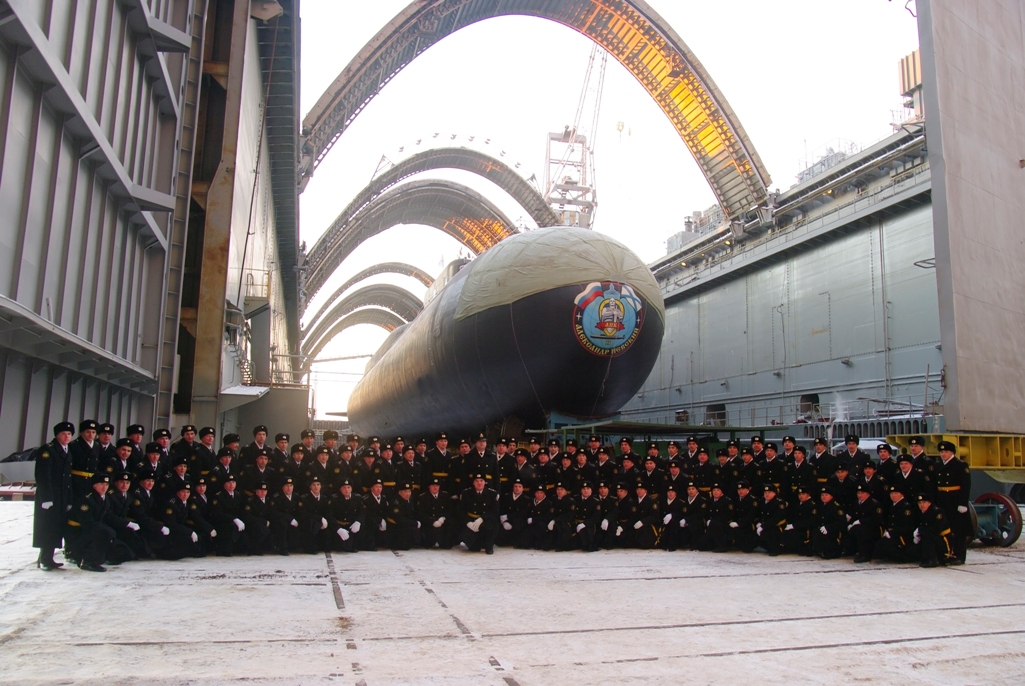
Kilo SS "Novorossiysk" August 22, 2014
(Image courtesy of Admiralty Shipyards)
There have been several statements by design and shipbuilding industry officials over the past year discussing an interfleet transit of the first new domestic Project 636.3 Kilo-class diesel submarine, "Novorossiysk", to the Northern Fleet area for additional testing. After the submarine joined the Russian Navy on August 22 of this year, everyone has been wondering when it will depart.

"Novorossiysk" conducted a 30-hour check ride on October 11-12 before returning to Admiralty Shipyards - the submarine's only underway period since being commissioned. Two auxiliaries arrived at the shipyard yesterday, probably in support of the transfer: Goryn-class oceangoing tug MB-119 (which first towed Bereza-class degaussing vessel SR-926 to Kronshtadt) and Toplivo-class oiler VTN-34.

Also visiting Admiralty Shipyards yesterday was Sidehole-class harbor tug RB-250, which made a round trip from Angliyskaya Naberezhnaya, and passenger ferry PSK-1562, which made a round trip from  Kronshtadt.

Admiralty Shipyards doesn't normally see this much visitor traffic, so it's a good sign that something unusual is about to occur. And it's not related to factory sea trials for Belousov-class submarine rescue ship IGOR BELOUSOV, as that ship has not even completed initial deperming operations. And the next transfer of Vietnamese Kilo "Haiphong" won't happen until later this year - and that will involve a semi-submersible heavy-lift ship, not a smaller oceangoing tug.

Yantar Baltic Shipyard Orders Equipment for Second Gren Landing Ship

Gren LST "Ivan Gren" - May 23, 2012
(Image courtesy of TASS)

Yantar Baltic Shipyard in Kaliningrad has begun ordering parts for Project 11711 (Factory #01302) - the second Gren-class landing ship (as yet unnamed). According to an October 9 Request for Proposals, the shipyard is seeking to purchase the following:

DMU-20-10 metering device (x14)
1FShch 20/10-0.15 filter (x1)
1FShch 65/6-0.25 filter (x4)
2FMT 50/6-1-1 filter (x6)
FMT 80/6-1-1 filter (x1)
FMT 100/6-1-1 filter (x2)
PTsZ-3-0.63-KRD-2 (VNTA.061611.009-02) pressure tank (x1)
PTsZ-Pp-1,0-KRD-2 (VNTA.061611.005-01) pressure tank (x1)
SPRU-300-8 chemical mixer (x1)

The contract for this equipment is worth RUB 10,573,890 and must be fulfilled by the third quarter of 2015.

Today, the general director of Neva Draft Design Bureau, Sergey Vlasov, confirmed that a decision has been made to complete construction of a second Gren-class landing ship, which was laid down in 2004. The ship will be built using the design for the first unit, "Ivan Gren", but with a few modifications based on lessons learned during construction of the lead ship. Vlasov stated that "a number of imported equipment will be replaced with domestic versions."

The design bureau is also working on a new landing ship design. "On our own initiative we are now preparing materials to brief the Navy Commander-in-Chief," Vlasov said. "After that, everything will depend on the Navy's decision."

Monday, October 13, 2014

Court is Now in Session: "Pseudo-Space Vehicle" for Russian Navy


Image courtesy of Getty Images

One December 13, 2012, the Russian Federation Ministry of Defense filed a petition with the Moscow Arbitration Court seeking RUB 1,921,920 in penalties against the Russian Federal Space Agency's Central Scientific Research Institute of Machine-Building (CSRIM) for non-fulfillment of obligations under State Contract N/2/2/08-11-DOGOZ (dated November 9, 2011). Specifically, the MOD accused CSRIM of not completing Stage 1 of scientific research work (NIR) "Kosmos-Krylo" by the agreed-to deadline. The NIR covered the creation of a "pseudo-space vehicle" that would be used for targeting and electronic warfare related to an improved system for exchanging Navy data with submarines and surface ships. According to the contract, Stage 1 of the NIR (worth RUB 40,000,000) was to be completed between the date the contract was signed and by November 25, 2011. The entire NIR was to be conducted between November 1, 2011, and November 25, 2013, for which the MOD would pay CSRIM RUB 166,400,000 incrementally.

In court, CSRIM argued that it did not receive official notification that it had won the contract until November 24, 2011 - one day before Stage 1 of the NIR was to have been completed. On January 26, 2012, CSRIM sent a letter to the MOD requesting the Stage 1 deadline be extended to March 2012 due to late arrival of the official contract notification. On February 6, CSRIM sent a letter to the MOD requesting that co-contractors and Military Representation Offices (MRO) be brought into to assist with the work. On February 10, the MOD concurred with the request, and the two sides signed Decision 2/5/12-DOGOZ, under which co-contractors would be brought in for Stage 1 of the NIR. On March 7, the MOD sent letters to the respective MROs.

On March 19, 2012, both sides signed Supplementary Agreement N/2/2/08-11-DOGOZ-2 by which the deadline for completion of Stage 1 of the NIR was set as March 31, 2012. On May 12, 2012, the MOD accepted CSRIM's research work with no complaints.

However, on July 31, 2012, the MOD sent a letter to CSRIM claiming the latter owed RUB 1,863,680 for being 42 days late in completing Stage 1. On August 27, 2012, CSRIM responded that the MOD had violated the Stage 1 deadline as MROs 153, 1382, 4116, and 5262 were brought in to the contract very late (March 7, 2012). As the MROs didn't actually start work until the second half of March, CSRIM could not complete Stage 1 by the agreed-to deadline. CSRIM also argued that the technical requirements for the interdependent contract should have been established by the MROs before the contract was signed with the co-contractors.

On May 8, 2013, the Moscow Arbitration Court ruled (Case A40-163464/12) that there was no basis for the MOD's petition for the penalty payment, as CSRIM had done everything it could to satisfy its contractual obligations despite the MOD's failure, in a timely manner, to inform CSRIM that it had won the contract and to coordinate the inclusion of MROs and co-contractors.

On June 19, the MOD filed an appeal with the 9th Arbitration Appellate Court. The two main elements of the MOD's appeal were (a) the date when the MROs and co-contractors were brought into the contract should have no effect in CSRIM's execution of Stage 1 of the NIR, and (b) the MOD, and not the MROs, establishes the technical requirements of the NIR. On 30 July, the Court also ruled (Decision 09AP-22734/2013-GK) in favor of CSRIM.

On October 3, the MOD filed an appeal with the Moscow Dictrict Federal Arbitration Court, and on November 13, the Court ruled (Decision A40-163464/12-85-986) in favor of the MOD. In its ruling, the Court explained that both of the lower Courts placed the burden of proving CSRIM did not do everything it could to fulfill its contractual obligations on the MOD instead of forcing CSRIM to prove it did. As such, the Court ordered the case be sent back to the Moscow Arbitration Court. The Court also pointed out that the March 2012 Supplementary Agreement did not change the conditions of the original contract; i.e., inclusion of MROs and co-contractors did not change the agreed-to contract deadline.

On June 26, 2014, following a second review of the case, the Moscow Arbitration Court passed a partial ruling in favor of the MOD by ordering CSRIM to pay a penalty of RUB 1,601,600 (reduced from the original RUB 1,921,920) for late completion of Stage 1 of the NIR.

Both CSRIM and the MOD filed appeals with the 9th Arbitration Appellate Court on August 7 and August 25, respectively. On September 30, the 9th Arbitration Appellate Court denied both appeals (Decisions 09AP-36963/2014-GK and 09AP-38958/2014-GK), letting the lower court's decision stand. Both sides have until October 30 to file appeals, but given its earlier decision, the Moscow District Federal Arbitration Court is likely to uphold the lower Courts' decisions.

Saturday, October 11, 2014

Court is Now in Session: Severodvinsk SSGN

Severodvinsk SSGN "Severodvinsk"
(image courtesy of SevMash)
On August 3, 2012, the Russian Federation Ministry of Defense filed a petition with the Moscow Arbitration Court seeking RUB 68,736,790 from Malakhit St. Petersburg Naval Bureau of Machine-Building as a penalty for exceeding the deadline of a 1986 design contract related to Severodvinsk-class nuclear-powered submarine (SSGN) "Severodvinsk".

The following timeline provides some background and context to the case:
  • On October 31, 1986, the MOD and Malakhit signed State Contract Number 102/86-Ye/554-86 for experimental design work (OKR) "Project 885" [Project 885 = Severodvinsk SSGN]. Under the contract, Malakhit was to produce design documentation for the Severodvinsk SSGN.

  • On December 21, 1993, "Severodvinsk" was laid down at SevMash.

  • Between 1996 and 2000, no major work was performed due to a lack of financing. Following some redesign work and with a new flow of money, construction recommenced in 2001.

  • In February 2002, SevMash officials stated that deliveries of equipment from sub-contractors were delaying the submarine's construction.

  • By July 2007, the submarine's reactor has been installed, and the steam turbine plant was to be delivered "soon."

  • On April 8, 2009, the MOD issued a decision to test 22 prototype pieces of equipment on the submarine as a whole during factory sea trials. The prototypes listed in the MOD's decision included items designed by Malakhit under OKR "Project 885". Malakhit explained to the MOD that it could not finalize the working design documentation until all testing was completed.

  • On June 15, 2010, "Severodvinsk" was finally launched.

  • On March 31, 2011, the two sides signed Supplementary Agreement Number
    N/1/2/0217/D54-11-D203, under which Malakhit was to complete OKR Stages XXVII 3.1.3.3 (Rakonda automatic control system), 3.1.3.6 (Bulat-Ya integrated technical equipment control system), 3.1.3.7 (Mineral-Ya electro-hydraulic equipment package), 3.1.3.9 (SM-346 launcher and SM-353 universal loading device), and 3.3 by November 25, 2011.

  • On September 12, 2011, "Severodvinsk" got underway for its first day of factory sea trials.

  • On May 29, 2012, the MOD formally complained to Malakhit about non-fulfillment of its contractual obligations. When the two sides could not resolve this issue, the MOD filed its suit in August.
In court, Malakhit argued that it had fulfilled all contractual obligations that did not depend on SevMash, which built "Severodvinsk". All other obligations were hampered by SevMash's continued testing of the submarine. And the judge agreed, ruling in favor of Malakhit on February 8, 2013.

On May 8, 2013, the MOD filed an appeal with the 9th Arbitration Appellate Court, which also ruled in favor of Malakhit on June 19. On August 30, 2013, the MOD filed its final appeal with the Moscow District Federal Arbitration Court; it, too, ruled in favor of Malakhit on October 14.

Two months later, on December 30, the MOD took possession of "Severodvinsk". It joined the RF Navy on June 17, 2014, although the submarine still remains in a "trial operation" status.

Thursday, October 9, 2014

Times are Changing in Russia

New time zone conversions that go into effect on October 26, 2014
On July 21, 2014, President Putin signed Federal Law 284-FZ "Introduction of Amendments to the Federal Law 'Computation of Time'", which earlier had been passed by the State Duma (July 1) and Federation Council (July 9). Under 284-FZ, most Russians will turn the clocks back one hour at 2am on October 26. After the change, Russia will not revert back to daylight saving time ("spring time") in 2015. The law also expands the number of time zones in Russia from 9 to 11.

For those watching Russian Navy events, the new time zone conversions from GMT will look like this:

RF Navy HQ
  • Moscow: GMT + 3
Baltic Fleet
  • Kaliningrad: GMT + 2
  • St. Petersburg: GMT + 3
Black Sea Fleet
  • Sevastopol: GMT + 3
  • Novorossiysk: GMT + 3
Caspian Flotilla
  • Astrakhan: GMT + 3
  • Makhachkala: GMT + 3
Northern Fleet
  • Severodvinsk: GMT + 3
  • Severomorsk: GMT + 3
Pacific Fleet
  • Sakhalin Island: GMT + 10
  • Southern Kurils: GMT + 10
  • Vladivostok: GMT + 10
  • Northern Kurils: GMT + 11
  • Petropavlovsk-Kamchatskiy: GMT + 12
  • Rybachiy: GMT + 12

Tuesday, October 7, 2014

XLT: Admiral Viktor Chirkov Discusses Black Sea Fleet Issues

Admiral Viktor Viktorovich Chirkov - RF Navy Commander-in-Chief
(image courtesy if RIA Novosti)
(Translation of RIA Novosti interview with Admiral Chikrov)

RF NAVY CINC: BSF TO RECEIVE 30 NEW SHIPS BY 2020
RIA Novosti
06.10.2014
http://ria.ru/interview/20141006/1027138432.html

Following the reunification of Crimea and Russia, only Russian ships and submarines will moor in the Black Sea Fleet's main base in Sevastopol. Russia will no longer make lease payments to Ukraine to base the Russian fleet in the City of Russian Glory. And now there is the question of expanding the presence of Black Sea Fleet ships in the Crimea by using facilities and bases once used by the Ukrainian Navy.

As part of the "Crimea Today" project, Sergey Safronov, head of RIA Novosti's defense editorial section, talked with RF Navy Commander-in-Chief Admiral Viktor Chirkov about the Russian Navy's plans for development of the Black Sea Fleet.


Comrade Commander-in-Chief, what missions does the Black Sea Fleet have under the new geopolitical conditions that have emerged?

— The missions remain unchanged. The primary ones — together with the navies of Black Sea states, to promote stability in the Black Sea and to ensure security for peaceful economic activities and shipping. But along with this, I would like to mention that we have the capability of executing these missions more effectively. Above all, we are now confident that developing the Black Sea Fleet and maintaining its fighting capabilities will occur in a programmatic manner, without any artificial impediments. We have always striven and will continue to strive to have a balanced Black Sea Fleet in terms of composition and combat capabilities so that it will be capable of executing missions to ensure the security of our southern maritime axes in its operational area of responsibility, as well as to effectively work together with the forces of other branches and services of the Russian Federation Armed Forces. These missions are not changing.

We are following this course while implementing the directives of the RF Minister of Defense and in an effort to execute a shipbuilding program in the interests of the Black Sea Fleet on a priority basis. For well-known reasons, the fleet was aging uncontrollably. Now we are putting an end to this destructive aging process, we are revitalizing our subsurface and surface forces, we are organizing the basing infrastructure for Black Sea Fleet forces in the Crimea, and we are reviving the ship repair system. And this will allow Black Sea Fleet sailors to effectively and fully carry out their missions in the Black and Mediterranean Seas, to include as part of the Mediterranean Sea standing operational group.

How will the Black Sea Fleet basing system be developed, and, specifically, will the purpose of the Novorossiysk basing point change?

— The "Creation of a Black Sea Fleet Basing System on RF Territory in 2005-2020" federal targeted program, which addresses the construction of a basing point for Black Sea Fleet ships and vessels in Novorossiysk, will be completed in full. Geoport, with its unique protective seawall, will become another basing point for Black Sea Fleet forces together with the basing of forces in the main base - in the city of Sevastopol. The Black Sea Fleet will have a truly integrated basing system on the Crimean Peninsula, which includes the Black Sea Fleet's main base - Sevastopol - and other basing points. This basing system and infrastructure will be self-sufficient; that is, able to provide for a full cycle that allows for the comfortable basing of surface ships, submarines, and coastal troops with corresponding social infrastructure facilities.

How will the Black Sea Fleet be augmented and revitalized over the coming years?

— In accordance with the military shipbuilding program, over the next six years about 30 combatant ships of various classes will join the Black Sea Fleet. I am talking about first-, second-, third- and fourth-rank ships and auxiliary vessels. And I am not talking about an unjustified build-up of forces. These are long overdue needs of the Black Sea Fleet, which has not been revitalized for many years.

By the end of the year, the Black Sea Fleet will receive two of six Project 636 submarines. These are the "Novorossiysk" and "Rostov-na-Donu" submarines. Also by the end of the year, we plan to raise the flag on the first of six Project 1135.6 escort ships, which are being built for the Black Sea Fleet. These ships can operate both independently and as part of a grouping of fleet forces. Ships of this class are ideally suited for Black Sea waters and for operations beyond its borders. For example, as part of the Navy's Mediterranean Sea standing operational group. Escort ships of this type are capable of effectively conducting counter-piracy missions in the Gulf of Aden. Also joining the Black Sea Fleet will be six Project 22160 open-sea patrol ships, which are designed to carry out patrols to protect territorial waters, to patrol the 200-mile exclusive economic zone in open and closed seas, to protect ships and vessels during sea voyages, as well as to protect naval bases and water areas in order to warn of an attack by various enemy forces and means, to interdict illegal and pirate activities, to search for and render assistance to victims of maritime accidents, and to monitor the environment.

The Black Sea Fleet search and emergency rescue service has longed need to be revitalized and modernized. What is the Navy HQ planning to do in this area?

— The Black Sea Fleet rescue forces received a new rescue craft, which was built using a modular approach. It is attached to the Black Sea Fleet diver school (Sevastopol), which is part of the Navy Combined Training Center. On a side note, the Project 23370 modular craft is the Navy's first vessel to be built using a modular approach, and it provides new capabilities for search and rescue forces of the Navy as a whole and of the Black Sea Fleet in particular.

By the end of 2014, the Russian Navy's search and emergency rescue service is scheduled to have seven Project 23370 modular search and rescue craft in its inventory. In the near future, Navy rescuers will be equipped with a total of 12 such craft. By the end of this year, there will be six new auxiliary vessels to provide integrated support for operations by Black Sea Fleet surface and subsurface forces.

A topic of special concern for the Black Sea Fleet has always been hydrographic support for shipping safety. What is the situation like in this area now?

— The task of reestablishing regular hydrographic surveys in the Black Sea Fleet's operational zone in the interests of shipping safety has been long overdue. For these goals, the 10th Oceanographic Expedition of the Black Sea Fleet Hydrographic Service was established; three hydrographic vessels have already been assigned. By 2016 we plan to exclusively revitalize the inventory of hydrographic vessels in the Black Sea Fleet. I am talking about the introduction of new hydrographic vessels, and particularly of modern large hydrographic vessels, into the fleet.

What can Black Sea Fleet naval aviation expect?

— Black Sea Fleet naval aviation has received an opportunity to expand and restore its capabilities. We have begun to rearm the pool of aircraft. Replacing the SU-24 aircraft are the new SU-30MS. Robust repairs of existing Black Sea Fleet airborne vehicles (helicopters and aircraft) will allow us to achieve a level of 80% this year. That's not bad at all.

—  How will the NITKA facility be used?

— We have a clear understanding of the function and use of the training facilities (NITKA) at Saki and Yeysk. In Saki, we will train pilots of existing shipborne aircraft, while the new NITKA in Yeysk will be used for scientific research purposes and for studying new, advanced airborne vehicles. And there is logic to this. We have the opportunity to provide continuous pilot training and to use what currently exists for the future.

What is the situation with ship repairs for the Black Sea Fleet in Crimea?

— That is a standing topic — ship repairs in the Black Sea Fleet. The military ship repair system in Crimea is coming to life. Contracts are being signed.

We have an opportunity to fully exploit the capabilities of the "Black Sea Fleet 13th Shipyard (13 SRZ)" Federal State Unitary Enterprise (FSUE). After the well-known events of 1991, there were serious obstacles to repairing Black Sea Fleet ships. This significantly complicated how issues related to maintaining and restoring combat ships' technical readiness were solved.

For the 13 SRZ, in the near future we plan to have production areas, which meet modern requirements and technologies, to purchase new equipment, and to begin a phased replacement of machining workstations with the goal of servicing newer ships that will begin to join the Black Sea Fleet starting in 2014. These efforts are already underway. The shipyard has come back to life. As an example, the 13 SRZ in Sevastopol has already repaired a second Northern Fleet large antisubmarine warfare ship that was part of the Mediterranean Sea standing operational group. And the Black Sea Fleet submarine "Alrosa" is undergoing repairs at this same shipyard. Employee salaries have been brought up to a Russia-wide level. Any social strain has been lifted.

Based on its composition, the Black Sea Fleet should execute its missions, as intended, in full. And for this, it is necessary to boost the ship inventory to a commensurate level.

Saturday, October 4, 2014

Russian Crews Train on Mistral "Vladivostok"

Political cartoon showing the U.S. attempting to sink the Mistral deal between France and Russia
(Image courtesy of RIA Novosti/Vitaliy Podvitskiy)

"Vladivostok", Russia's first Mistral-class amphibious landing ship built by France, has conducted two rounds of underway training periods for Russian Navy crews over the past three weeks. The first nine-day period took place on September 13-21, while the second nine-day period took place on September 24-October 2. The landing ship twice reached a top speed of 18.3 knots -- on Day 6 (September 19) and Day 7 (September 29) of the respective underway periods. You can watch a replay of both underway training periods here and here.

The 2011 Mistral contract called for delivery of the first ship to Russia in October 2014. Following Russia's annexation of the Crimea and further military actions in eastern Ukraine, French president Francois Hollande stated in July that while the delivery of the first ship would probably occur, a decision to deliver the second Mistral unit - "Sevastopol" - would be reviewed. In an interview with Le Monde in August, the French president said that European sanctions enacted at that point did not prevent France from delivering the ship to Russia. In early September, however, Hollande backtracked slightly when he said that he would decide in late October whether proper conditions exist to authorize delivery of "Vladivostok" to Russia -- an effective cease-fire and a clear path to a political settlement of the crisis in eastern Ukraine.

This week, RosOboroneksport deputy general director Igor Sevastyanov told reporters that Russia plans to sign documents for delivery of "Vladivostok" in late October-early November. Also this week, Deputy Minister of Foreign Affairs Aleksey Meshkov and Speaker of the State Duma Sergey Naryshkin both stated that France, so far, was fulfilling its contract obligations on schedule.

Monday, September 29, 2014

XLT: Buran-6M, Uragan-P Communications Suites

Delta IV SSBN
(image courtesy of Wikipedia)
(translation of Control Systems Holding Company press release)

UIC Equips New “Okean” Escort Ship with Modern Communications Suite

Moscow/August 21, 2014

Control Systems Holding Company (part of the United Instrument-Production Corporation (UIC)  - RosTekh State Corporation) has completed delivery of a Buran-6M unique, multifunction communications suite for the lead unit of the new generation Project 22100 “Okean” class of escort ships.

“Okean” is the first ice-class ship to be fully designed in accordance with the requirements of the Border Service – Federal Security Service of Russia. Based on its overall characteristics, “Okean” has no equal among vessels of its class.

The Buran-6M automated communications suite (ACS) installed on the “Okean” was manufactured at one of Control Systems’ companies – Neptun Scientific Research Institute (SRI). The suite provides communications between ships in a group and shore-based control posts, transfers data to ship- and land-based airborne vehicles, receives and transmits files over radio channels, shares data with the shipboard combat information management system, and records communications. The Buran system includes a “drive” mode for airborne vehicles, which supports the launch and recovery of shipborne helicopters while taking into consideration all safety requirements for civilian and military aircraft.

“At the heart of the Buran-6M ACS are hardware components that, in terms of power, exceed similar components produced by us in previous years,” notes UIC department director Aleksandr Kalinin. “Ethernet network technology has been introduced into the communications suite, and this allows for modern digital communications hardware to be connected to the system. The suite uses open architecture, which provides broad capabilities for future upgrades and integration of modern technologies and resources, which are necessary to defend the State border.”

Neptun SRI also has completed development of another modern transmission suite, which will be used in the Uragan-P submarine communications suite.

“The transmission suite was fully created using technology developed by Neptun SRI that has no equal among technologies used in the Russian Navy,” said Control Systems acting general director Andrey Riznyk. “The technology is designed to transmit information from a submarine to control posts during independent operations. The output of the transmission suite significantly exceeds the capability of earlier equipment, which allows for increased communications range and continuity.”

The use of special software in the Uragan-P suite reduces the possibility of operator error. The suite uses open architecture, it has the capability of being further upgraded, and its functionality can be expanded.

Overhauled Kilo Subs Remain Kalibr-less

Kilo "Vladikavkaz" - September 19, 2014
(Image courtesy of Zvezdochka Ship Repair Center)
Six new (Project 636.3) Kilo-class diesel submarines are being built for the Russian Navy at Admiralty Shipyards in St. Petersburg. All six, which are destined for the Black Sea Fleet, will be armed with the Kalibr-family of missiles: the SS-N-27 Sizzler anti-ship cruise missile, the SS-N-30 land-attack cruise missile, and the 91R ASW missile. But will happen with the older Kilos?

Two 25-year-old Northern Fleet Kilos have undergone overhauls at Zvezdochka Ship Repair Center in Severodvinsk, but the overhauls apparently do not include backfitting them with the Kalibr system.

"Kaluga" arrived at the shipyard in 2002 for repairs, but without a decision on whether to repair or scrap the submarine, it remained idle for about six years. In 2008, Onega Scientific Research Technological Design Bureau drafted documentation for "medium repairs" (i.e., overhaul, which gives the submarine another 10 years of service) of the submarine, but only in 2010 was "Kaluga" finally moved into a repair hall. The submarine was rolled back out in May 2012. In 2013, the shipyard made it clear that "Kaluga" was not backfitted with the Kalibr system.

"Kaluga" was inactive so long that the crew it had in 2002 had been nearly disbanded, reduced to just a few crew members. As such, the crew of another Kilo, "Yaroslavl" (commanded by Captain 2nd Rank Oleg Mikholap), manned "Kaluga" throughout its post-overhaul sea trials (2012-2013) and transfer back to Polyarnyy (July 2013). In 2013, Mikholap was replaced by his executive officer, Captain 3rd Rank Yuriy Gusarov, as the "Yaroslavl" commanding officer; however, as "Yaroslavl" was non-operational, Gusarov's crew remained on "Kaluga". In October-November 2013, just three months after returning from the shipyard, "Kaluga" (under Gusarov's command) conducted a month-long deployment (area unknown). Gusarov and his crew remained on "Kaluga" as late as June 2014 and could still be on board.

The second Kilo to be overhauled at Zvezdochka Ship Repair Center, "Vladikavkaz", was transferred to Severodvinsk in 2008. Due to a similar "indecision-making" process, a contract for the submarine's "medium repairs" was not signed until 2011. The submarine was rolled into the repair hall in late 2011 for a nearly two-year overhaul period. The submarine rolled out of the repair hall on September 19 of this year and will be returned to the Russian Navy in late 2015.

Although neither Kilo was backfitted with the Kalibr missile system, they did receive the MGK-400V.1 sonar system, which provides improved sonar capabilities. Other upgrades were made to navigation and weapons-related components.

Next up: either "Magnitogorsk" or "Yaroslavl". "Magnitogorsk" has been performing duties in the Baltic Fleet since late 2013 (it did a similar Baltic Fleet deployment in 2012). Its return to the Northern Fleet may have been delayed until one of the Baltic Fleet's own Kilos, "Vyborg", returns to service following lengthy repairs. "Yaroslavl" has been inactive for at least two years. As with "Kaluga" and "Vladikavkaz", none of these old Kilos are expected to receive Kalibr upgrades.

Wednesday, September 24, 2014

Update: "Transshelf" Departs Russia with Nuke Boats

Akula I SSN "Bratsk" (left) and "Samara" (right) loaded on "Transshelf" - August 2014
(image courtesy of vkontakte.ru)

Nuclear-powered icebreaker "50 Let Pobedy" escorting "Transshelf" - September 16, 2014
(image courtesy of RosAtomFlot)
Dockwise semi-submersible heavy-lift vessel "Transshelf", with Akula I-class nuclear-powered submarines "Bratsk" and "Samara" loaded on board, arrived in the vicinity of Severodvinsk on September 23. According to a spokesperson for Zvezdochka Ship Repair Center, which has been contracted to conduct repairs and upgrades of the two submarines, "Transshelf" will remain near the Nikolskoye entrance buoy until weather improves.

For earlier reporting:

Why is the Netherlands Helping the Russian Navy Right Now? (August 14, 2014)

Nuke Boats Loaded on Heavy-Lift Vessels (August 28, 2014)

"Transshelf" Departs Russia With Nuke Boats (August 31, 2014)

"HYSY 278" Departs Russia With Oscar II SSGN (September 3, 2014)

Status of Russian Navy Nuke Boat Transfers (September 5, 2014) 

"HYSY 278" Arrives Near Bolshoy Kamen With Oscar II SSGN (September 7, 2014

Update: "Transshelf" Departs Russia With Nuke Boats (September 10, 2014)

Update: Status of Russian Navy Nuke Boat Transfers (September 11, 2014)

Update: "Transshelf" Departs Russia with Nuke Boats (September 16, 2014)

Update: "Transshelf" Departs Russia with Nuke Boats (September 19, 2014)

Dolgorukiy SSBN: The Dirty Secret Under the Hood

Dolgorukiy SSBN "Yuriy Dolgorukiy" underway in the White Sea - September 7, 2009
(Image courtesy of images.yandex.ru)
The Russian Navy’s newest class of nuclear-powered ballistic missile submarines is not as new as Moscow's submarine dealers would like you to know.

All of the Dolgorukiy-class (Project 955) SSBNs launched to date are actually hybrids of Akula SSNs and Oscar II SSGNs. I’m not sure why this isn’t more clearly explained in the English-language Wikipedia article, but it’s abundantly clear in the Russian-language version of the article.

If it were only the Frankenstein hull, then all debate could center on the third generation hull structure’s impact on the submarine’s theoretical tactical performance and detectability. But the hull is not the only borrowed item on this submarine.

It turns out that in addition to hull sections, the Dolgorukiy SSBN is borrowing used steam turbines from scrapped nuclear-powered submarines that were built nearly 30 years ago. This month, the Northeastern Repair Center in Vilyuchinsk (Kamchatka Peninsula) announced it was signing a contract (worth RUB 1,198,951) with the Far East subsidiary of Onega Scientific Research Technological Design Bureau (in Bolshoy Kamen, east of Vladivostok) for the “creation of technological and design documentation to support the removal of modular steam turbine plant equipment” plus “assistance during the deinstallation and removal of an Azurit-M modular steam turbine plant [from Oscar II SSGN “Krasnoyarsk”]" in the 4th quarter of 2014. The umbrella contract under which this work is to be done is Z/1/1/0169/GK-12-DGOZ, signed on May 25, 2012, which actually covers the construction of hulls 5-8 of the Dolgorukiy SSBN class. Thus, the steam turbine plant on “Krasnoyarsk” will be used in the construction of a future, new and improved Project 955A version of the Dolgorukiy SSBN (the 955A series started with the fourth hull, "Knyaz Vladimir"). And there is a strong suspicion that this has happened with some, if not all, of the earlier units, as well.

How much would you pay for a “new” car that used a frame constructed from 30-year-old cars and that was powered by a used engine?

Show me the Car Sub Fax!!!

Sunday, September 21, 2014

Exercise Vostok-2014 - Closures, Bans, Restrictions

Restricted areas for Vostok-2014 exercise - September 20-28, 2014 (Map courtesy of Google Maps)

An area closure, flight bans, and flight route restrictions have gone into effect in the Kamchatka Peninsula area in preparation for Russia's Vostok-2014 strategic command-staff exercise, which kicked off on September 19 and will run through September 25. The Pacific Fleet's Slava-class missile cruiser "Varyag" is on one-hour standby to get underway to launch missiles and fire its guns upon receipt of orders.
Area closure (red)
KAMCHATKA-SOUTHEAST COAST.
GUNNERY. MISSILES.
1. HAZARDOUS OPERATIONS 2000Z TO 1100Z COMMENCING
DAILY 20 THRU 27 SEP IN AREA BOUND BY
52-16-24N 158-51-30E, 53-05-48N 160-01-48E,
51-28-54N 163-34-00E, 51-08-18N 163-18-30E,
51-16-12N 162-11-00E, 50-06-18N 161-38-54E,
50-34-48N 160-14-30E, 51-23-54N 159-44-24E.
2. CANCEL THIS MSG 281200Z SEP 14.


Flight bans (yellow)
P6495/14 - AIRSPACE CLSD WI SECTOR FROM AZM 117 DEG TO AZM 168 DEG AT DIST FROM 32KM TO 50KM FROM PETROPAVLOVSK-KAMCHATSKY/YELIZOVO ARP. SFC - FL330, DAILY 0100-0300, 22 SEP 01:00 2014 UNTIL 25 SEP 03:00 2014.

P6625/14 - AIRSPACE CLSD WI SECTOR FROM AZM 117 DEG TO AZM 168 DEG AT DIST FROM 32KM TO 50KM FROM PETROPAVLOVSK-KAMCHATSKY/YELIZOVO ARP. SFC - 10000M AGL, DAILY 0100-0300, 26 SEP 01:00 2014 UNTIL 28 SEP 03:00 2014.


P6496/14 - TEMPO DANGER AREA FOR ACFT FLT ACT WI COORD:
5259N 16019E-5148N 16253E-5039N 16011E-5124N 15944E-5206N 15845E-5210N 15848E-5256N 16015E-5259N 16019E. SFC - 25000M AGL, DAILY 2000-0100 0300-0800, 21 SEP 20:00 2014 UNTIL 25 SEP 08:00 2014.

P6626/14 - TEMPO DANGER AREA ACT WI COORD:
5259N 16019E-5148N 16253E-5039N 16011E-5124N 15944E-5206N 15845E-5210N 15848E-5256N 16015E-5259N 16019E. SFC - 25000M AGL, DAILY 2000-0100 0300-0800, 25 SEP 20:00 2014 UNTIL 28 SEP 08:00 2014.


Flight route closures (green)
P6494/14 - FLW ATS RTE SEGMENTS CLSD:
B932 RAPAK - RIMLI,
G73  PETIN - TUSOM,
G801 KUNAD - RIMLI,
G815 KUNAD - DIROS,
G816 LUMES - RIMLI. SFC - 25000M AGL, DAILY 2000-0100 0300-0800, 21 SEP 20:00 2014 UNTIL 25 SEP 08:00 2014.

P6623/14 - FLW ATS RTE SEGMENTS CLSD:
B932 RAPAK - RIMLI,
G73  PETIN - TUSOM,
G801 KUNAD - RIMLI,
G815 KUNAD - DIROS,
G816 LUMES - RIMLI. SFC - 25000M AGL, DAILY 2000-0100 0300-0800, 25 SEP 20:00 2014 UNTIL 28 SEP 08:00 2014.

P6501/14 - ATS RTE SEGMENTS CLSD:
A812 BAKEN - PETIN,
B703 PETIN - LETSA,
G101 SOBOLEVO NDB (SW) - PETIN,
G583 MALKA NDB (MK) - UST-BOLSHERETSK NDB (UB),
G73  UST-BOLSHERETSK NDB (UB) - PETIN. SFC - FL140, 21 1900-2000, 22 0800-0900 1900-2000, 23 0800-0900 1900-2000, 24 0800-0900 1900-2000, 25 0800-0900, 21 SEP 19:00 2014 UNTIL 25 SEP 09:00 2014.

P6621/14 - ATS RTE SEGMENTS CLSD:
A812 BAKEN - PETIN,
B703 PETIN - LETSA,
G101 SOBOLEVO NDB (SW) - PETIN,
G583 MALKA NDB (MK) - UST-BOLSHERETSK NDB (UB),
G73 UST-BOLSHERETSK NDB (UB) - PETIN. SFC - FL140, 25 1900-2000, 26 0800-0900 1900-2000, 27 0800-0900 1900-2000, 28 0800-0900, 25 SEP 19:00 2014 UNTIL 28 SEP 09:00 2014.

P6502/14 - ATS RTE B932 SEGMENT RAPAK - RIMLI CLSD. SFC - FL330, DAILY 0100-0300, 22 SEP
01:00 2014 UNTIL 25 SEP 03:00 2014.

P6622/14 - ATS RTE B932 SEGMENT RAPAK - RIMLI CLSD. SFC - 10000M AGL, DAILY 0100-0300, 25
SEP 01:00 2014 UNTIL 27 SEP 03:00 2014.

Update: Impending Missile Launch from Kotelnyy Island?

Gunnery/missile area closures near Kotelnyy Island - September 15-25, 2014 (Map courtesy of Google Earth)
Russia has reissued and extended an area closure near Kotelnyy Island:
ARCTIC.
LAPTEV SEA.
MISSILES. GUNNERY.
1. HAZARDOUS OPERATIONS 2200Z TO 1800Z
COMMENCING DAILY 21 THRU 25 SEP IN AREA BOUND BY
75-53.4N 132-39.0E, 76-28.2N 133-08.0E,
76-50.8N 135-00.0E, 76-58.5N 136-26.1E,
75-57.7N 137-33.5E, 75-35.5N 137-00.0E,
75-37.5N 136-13.5E, 75-50.7N 135-41.0E.
2. CANCEL THIS MSG 261900Z SEP 14.
The new area closure (depicted in yellow above) is slightly different in shape when compared to the earlier closure (depicted in red) that remains in effect until tomorrow.

Moreover, the new area closure's effective dates (September 21-25) coincide nicely with the Vostok-2014 strategic command-staff exercise that kicked off on September 19 and runs through September 25. Whether or not this is related to the exercise, a missile launch from this Arctic island certainly will be linked by the media to the new "North" Joint Strategic Command. According to an ITAR-TASS unnamed "Ministry of Defense source," the new command will stand-up on/before December 1, 2014.

Saturday, September 20, 2014

Petersburg Diesel Submarine Construction Continues

Petersburg SS "Sankt-Peterburg" moored on Neva River in St. Petersburg - July 2010
(Image courtesy of Wikipedia)

Construction of the second hull of the Petersburg diesel submarine class, named "Kronshtadt", was restarted in July 2013 when a new contract (Z/1/2/0280/GK-13-DGOZ) was signed with Admiralty Shipyards. Construction was stopped in 2009 after the Russian Ministry of Defense decided it would no longer fund the plagued program following the poor performance and prolonged testing of the first hull, "Sankt-Peterburg". But "Kronshtadt" is now showing signs of life.

"Sankt-Peterburg" was laid down in December 1997 and launched in October 2004. During factory testing, multiple issues with sonar, power plant, and propulsion systems significantly impacted the submarine's ability to achieve the technical and tactical performance requirements set by the Russian Navy. The submarine was finally commissioned in April 2010 - but only for "trial operations." After several years of limited operations, the submarine was transferred from the Baltic Sea to the Barents Sea in October 2013 for additional at-sea testing. "Sankt-Peterburg", which remains in a "trial operations" status, apparently has conducted few (if any) at-sea operations since the transfer based on a total lack of reporting.

"Kronshtadt" was laid down at Admiralty Shipyards in July 2005, and little information about the submarine was known about it after construction was halted in 2009. Since the new contract was signed in July 2013, however, there have been signs that real construction is underway, as proven by a dozen contracts for equipment deliveries announced between December 2013 and now.

(Description / cost / delivery date)
  • 72V29KM rapid remote-control equipment / ??? / 1Q2015
  • hydraulic mooring anchor capstan / ??? /2Q2015
  • reserve propulsion system / ??? /1Q2016
  • LGS-42 winch / ??? / 2Q2015
  • oil-water separators / ??? / 1Q2015
  • ARM-5 automated steering apparatus / ??? / 4Q2015
  • automated air compressor systems / ??? / 1Q2015
  • Baget 41-10 computer / ??? / 3Q2015
  • modernization of Zhikler mast-raising devices / RUB 1,780,800 / ???
  • Gnom-2 acoustic digital recorder / ??? / 4Q2015
  • diesel generators / ??? / 3Q2015
  • MG-65 emergency underwater communications system / ??? / 2Q2015
  • diesel generator pedestals / RUB 5,332,671 / Jan 2015
When the new contract went into effect in July 2013, Admiralty Shipyards reported that "Kronshtadt" was scheduled for handover to the Russian Navy in 2017. While the completion dates for the above contracts seem to suggest a 2017 delivery date is possible, it remains to be seen if sub-contractors for components can stay on schedule.

Friday, September 19, 2014

Update: "Transshelf" Departs Russia with Nuke Boats

Locations of "Transshelf" and "Vaygach" - September 15-19, 2014 (Map courtesy of Google Earth)
Dockwise semi-submersible heavy-lift vessel "Transshelf", with Akula I-class nuclear-powered submarines "Bratsk" and "Samara" loaded on board, continues its transit of the Arctic Northern Sea Route. "Transshelf" transited through the Sannikov Strait on September 16, the Laptev Sea on September 17, and through the Vilkitskiy Strait and into the Kara Sea by September 18. Both vessels were traveling at nearly 14 knots at that point.

By 0800 GMT today, the two vessels had separated. "Vaygach" was dead in the water within Zaliv Volchiy, while "Transshelf" continued a 13.6-knot southwesterly transit of the Kara Sea. If it continues an average 13-knot speed of advance, "Transshelf" could arrive in Severodvinsk on September 22; however, it earlier had an estimated arrival date of September 23.

For earlier reporting:

Why is the Netherlands Helping the Russian Navy Right Now? (August 14, 2014)

Nuke Boats Loaded on Heavy-Lift Vessels (August 28, 2014)

"Transshelf" Departs Russia With Nuke Boats (August 31, 2014)

"HYSY 278" Departs Russia With Oscar II SSGN (September 3, 2014)

Status of Russian Navy Nuke Boat Transfers (September 5, 2014) 

"HYSY 278" Arrives Near Bolshoy Kamen With Oscar II SSGN (September 7, 2014

Update: "Transshelf" Departs Russia With Nuke Boats (September 10, 2014)

Update: Status of Russian Navy Nuke Boat Transfers (September 11, 2014)

Update: "Transshelf" Departs Russia with Nuke Boats (September 16, 2014)

Wednesday, September 17, 2014

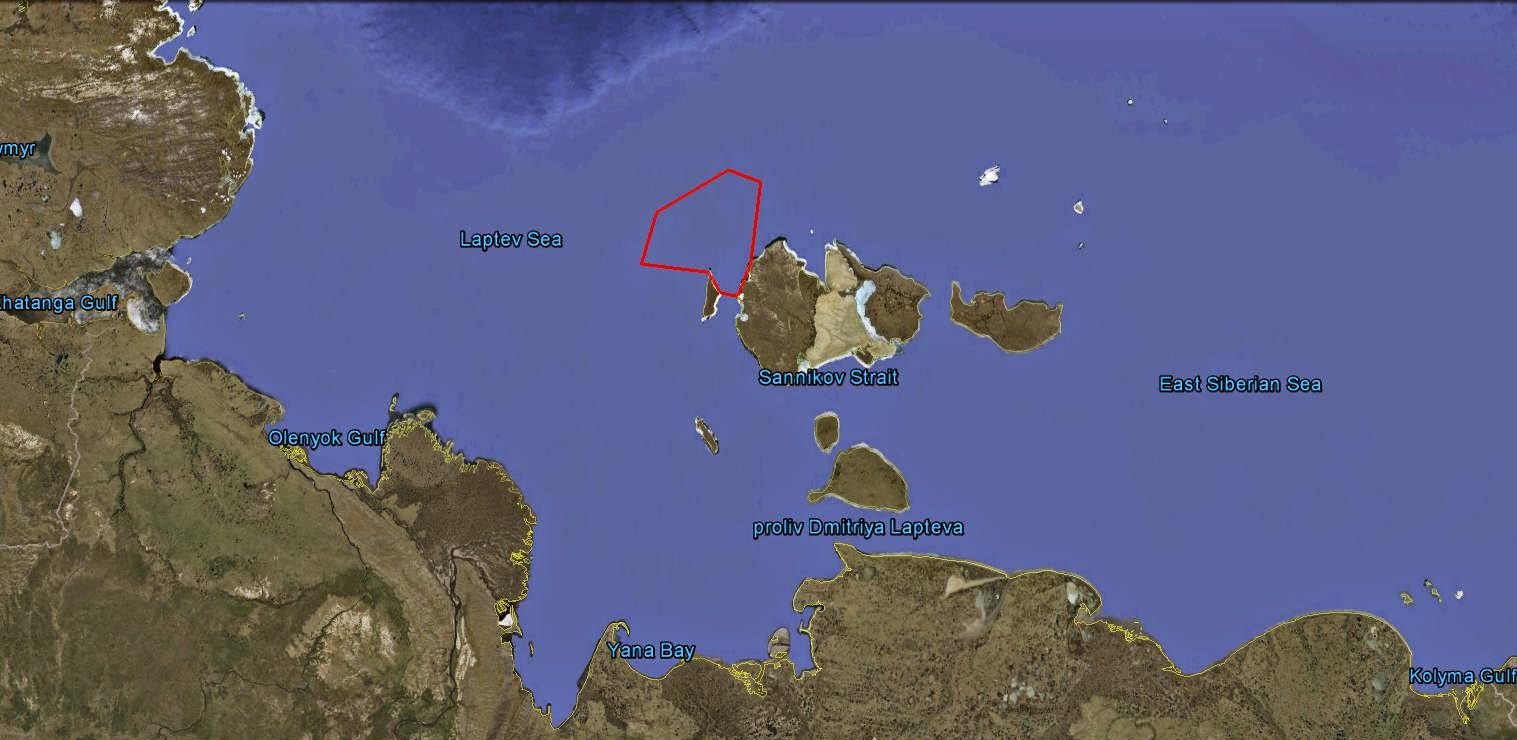
Impending Missile Launch from Kotelnyy Island?

Gunnery/missile area closure near Kotelnyy Island - September 15-21, 2014 (Map courtesy of Google Earth)
An interesting area closure has been declared west of Kotelnyy Island, where a Russian Navy Northern Fleet task group arrived this past weekend:
ARCTIC.
LAPTEV SEA.
MISSILES. GUNNERY.
1. HAZARDOUS OPERATIONS 0001Z TO 1600Z
DAILY 15 THRU 18 SEP IN AREA BOUND BY:
75-53.4N 132-39.0E, 76-28.2N 133-08.0E,
76-58.5N 136-26.1E, 76-50.8N 138-00.0E,
75-57.7N 137-33.5E, 75-35.5N 137-00.0E,
75-37.5N 136-13.5E, 75-50.7N 135-41.0E.
2. CANCEL THIS MSG 181700Z SEP 14.
ARCTIC.
LAPTEV SEA.
MISSILES. GUNNERY.
1. HAZARDOUS OPERATIONS 2200Z TO 1800Z
COMMENCING DAILY 18 THRU 21 SEP IN AREA BOUND BY:
75-53.4N 132-39.0E, 76-28.2N 133-08.0E,
76-58.5N 136-26.1E, 76-50.8N 138-00.0E,
75-57.7N 137-33.5E, 75-35.5N 137-00.0E,
75-37.5N 136-13.5E, 75-50.7N 135-41.0E.
2. CANCEL THIS MSG 221900Z SEP 14.
The area closure went into effect on September 15 and will expire on September 21. The warning messages indicated missiles would be launched during the closure times. Given that the closure touches the coastline, it is reasonable to believe a land-based coastal defense cruise missile (CDCM) will be fired. The Northern Fleet task group is comprised of six ships, only one of which is armed with any type of missile: Udaloy I-class destroyer "Admiral Levchenko" with its SA-N-9 Gauntlet AAW and SS-N-14 Silex ASW missile systems. It's highly unlikely the area closure was declared solely for these systems.

A late August Russian MOD press release reported that "coastal missile...units" were part of the "Admiral Levchenko" task group, but it didn't state whether the task group's two landing ships were ferrying the mobile CDCMs or if they were being ferried to the island by other means. At least five commercial vessels have made or soon will make trips to Kotelnyy Island this summer: "Aleksandr Suvorov", "Arkadiy Chernyshev", "Kapitan Borodkin", "Valeriy Vasilyev", and "Yuriy Arshenevskiy". The latter unit ferried unspecified military hardware to the island earlier this month.

At its farthest points (from Mys Durnoy (Zarya Strait) in the south to the northernmost coordinate), the area closure is just over 83nm in length. While it is unknown exactly which mobile CDCM systems may have been ferried to Kotelnyy Island, the length of this area closure could support launches by either the SSC-1B Sepal (approx. range 250nm) or SSC-3 Styx (approx. range 45nm). Given the Russians may place a target near the middle of the area or even closer to shore, it seems like a waste to launch the longer-range SSC-1B only 40 or so nautical miles. That distance, however, would be perfect for the near maximum range of the SSC-3.

A missile shot from the island will certainly be covered by both military and commercial media sources, at which we point we should be able to solve this riddle.

Tuesday, September 16, 2014

Update: "Transshelf" Departs Russia with Nuke Boats

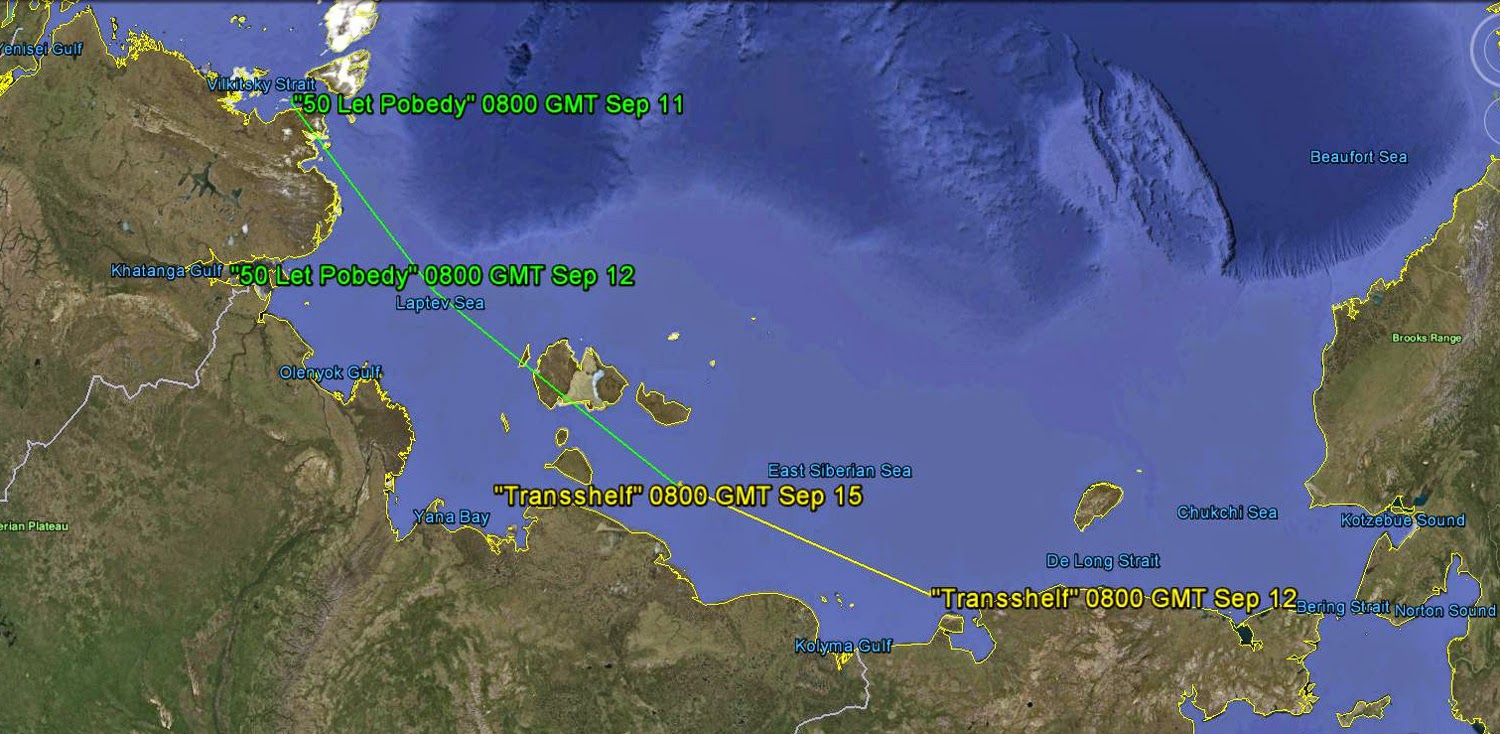
Locations of "50 Let Pobedy" and "Transshelf" - September 12-15, 2014 (Map courtesy of Google Earth)
Over the past weekend, the nuclear-powered icebreaker "50 Let Pobedy", which had earlier concluded icebreaker support for a Russian Navy Northern Fleet task group heading to the New Siberian Islands, rendezvoused with the Dockwise semi-submersible heavy-lift vessel "Transshelf" (with two Akula I-class nuclear-powered submarines loaded on board). The units began a westerly transit of the East Siberian Sea and were located approximately 115nm east of Bolshoy Lyakhovskiy Island (just south of Kotelnyy Island) at 0800 GMT on September 15.

"Transshelf" is now scheduled to depart the Northern Sea Route (NSR) on September 20, five days after the original end date of its approved transit window. On September 11, understanding the vessel would exceed the September 15 deadline, Zvezdochka Ship Repair Center requested an extension of the NSR transit window. The NSR Administration approved the request the following day and granted "Transshelf" permission to operate along the NSR through September 30.

For earlier reporting:

Why is the Netherlands Helping the Russian Navy Right Now? (August 14, 2014)

Nuke Boats Loaded on Heavy-Lift Vessels (August 28, 2014)

"Transshelf" Departs Russia With Nuke Boats (August 31, 2014)

"HYSY 278" Departs Russia With Oscar II SSGN (September 3, 2014)

Status of Russian Navy Nuke Boat Transfers (September 5, 2014) 

"HYSY 278" Arrives Near Bolshoy Kamen With Oscar II SSGN (September 7, 2014

Update: "Transshelf" Departs Russia With Nuke Boats (September 10, 2014)

Update: Status of Russian Navy Nuke Boat Transfers (September 11, 2014)

Monday, September 15, 2014

New SSBNs Will Not Transfer to Pacific Fleet in 2014

Dolgorukiy SSBN "Aleksandr Nevskiy" and crew - December 2010 (Photo courtesy of SevMash)

Despite multiple claims of the transfer of one or more Dolgorukiy-class nuclear-powered ballistic missile submarines to the Russian Navy Pacific Fleet this year, there are serious issues preventing this from happening.

"Aleksandr Nevskiy"
The submarine was accepted into the Navy on December 23, 2013, and it arrived at its new homeport of Gadzhiyevo a week later. The day after its arrival, SevMash (which builds the Dolgorukiy SSBN) reported plans to repair a "damaged shaft" on the submarine sometime in 2014. The estimated repair cost was stated at just under RUB 1.8 million, considerably less than a new shaft. The scope of damage is not known, but it appears it was damaged sometime during the transfer from Severodvinsk to Gadzhiyevo. If it was known that the shaft was damaged before leaving the White Sea, the submarine would have returned to SevMash.

To date there has been no mention of the shaft being repaired. More importantly, there has been no reporting of "Aleksandr Nevskiy" conducting even one day of underway training since arriving at Gadzhiyevo. All news articles mentioning the submarine this year have focused on speculation of an inter-fleet transfer or possible SS-N-32 Bulava SLBM launches.

"Aleksandr Nevskiy" Crew 1, until recently commanded by Captain 1st Rank Vasiliy Tankovid, underwent submarine training at the 270th Training Center (Sosnovyy Bor) in January-April 2014. Following a brief vacation period, Tankovid apparently was replaced by Captain 2nd Rank Aleksandr Nadezhdin, who was the commanding officer of "Vladimir Monomakh". Reporting this year continues to show Nadezhdin on board "Vladimir Monomakh", which could suggest he will not transfer to "Aleksandr Nevskiy" until its repairs are completed.

The window for conducting an under-ice inter-fleet transfer is quickly closing. A review of prior under-ice transfers shows August-September as the optimal period for such an operation. Before such an operation can be undertaken, however, you need to have a fully functional submarine and a highly trained crew, neither of which appears to exist today.

Finally, an anonymous "source in the Navy Main Staff" told ITAR-TASS in late March that, in fact, "Aleksandr Nevskiy" and "Vladimir Monomakh" would conduct under-ice transfers to the Pacific Fleet in the fall of 2015.

Base infrastructure
Waterfront infrastructure upgrades at Rybachiy Submarine base (Russian Far East - Kamchatka Peninsula) to support Dolgorukiy SSBN basing have been underway for at least two years. In 2013, construction of a new weapons handling pier at Mys Kazak (near Rybachiy Submarine Base) was underway. Contracts related to the pier covered the delivery of Japanese-manufactured sheet piling, 5,000 cubic meters of concrete, and multiple electrical connections to the local power grid, to name a few.

The infrastructure upgrades have been plagued by at least two significant worker accidents. On October 28, 2013, a 28-year-old bulldozer operator from the Monolit construction company was killed when 50 tons of dry cement fell on a shed where he was taking a break. And the source of that cement, which is being used for the Rybachiy Submarine Base infrastructure upgrades, may be imported through shady dealings (business as usual in the Far East) via ITA, according to a Kamchatka local newspaper.

On February 11, 2014, a sling operator was seriously injured after the sling of a wheeled crane broke during the removal of sheet piling. The accident occurred 22 meters from the end of a new deep-water pier under construction at the 3002nd Missile Handling Facility (Mys Kazak).

Complicating the situation was a court case in July of this year in which Mikhail Lunyakov (Chief of Special Construction-Engineering - Federal Special Construction Agency (SpetsStroy)) received an administrative fine of RUB 20,000 by the 289th State Architecture and Construction Oversight Office (headed by Vadim Lapushkin) for failing to receive permission before beginning construction work related to Pier 1 of the missile handling facility. It's never a good thing when government agencies sue each other.

Despite these minor setbacks, SpetsStroy continues to report progress in the infrastructure upgrade project. In June 2014, the agency claimed construction of the "pier zone" was on schedule. In July, SpetsStroy reported renovation of a 400psi high-pressure air compressor station and a personal rescue equipment inspection station also were on schedule.

In late August, General Surovikin, head of the Eastern Military District, stated "Aleksandr Nevskiy" should transfer to the Pacific Fleet by the end of 2014. But reporting during Russian Navy Commander-in-Chief Admiral Viktor Chirkov's visit to the submarine base in early September is strikingly different. Instead of the submarine arriving this year, defense ministry reporters stated Dolgorukiy SSBNs would join the Pacific Fleet "in the future."

So, regardless of claims you have already heard and others you may hear later this year, no Dolgorukiy SSBN will be transferring to the Pacific Fleet in 2014.

Friday, September 12, 2014

"Severodvinsk" Nuke Sub Heads for New Home

"Severodvinsk" departs Severodvinsk, September 11, 2014 (Photo courtesy of radikal.ru)
Following a no-frills send-off ceremony, the Russian Navy Northern Fleet's Severodvinsk-class nuclear-powered cruise missile submarine "Severodvinsk" departed the port of Severodvinsk (White Sea) on September 11 en route to its new permanent base of Guba Zapadnaya Litsa (about 35 miles northwest of Severomorsk). The journey should take only two days. The first (and only) time "Severodvinsk" departed the White Sea was a month and a half ago when it participated in Navy Day celebrations in Severomorsk. Shortly after the celebrations, the submarine returned to Severodvinsk.

There were a few hints the submarine was preparing to depart the White Sea:

  • On September 3, SevMash shipyard reported that the submarine would be heading to its permanent home port of Guba Zapadnaya Litsa this fall.
  • On September 10, the Severodvinsk mayor's office reported that the submarine had received two stationary bike trainers and TV monitor from the city. Since it wasn't a holiday, and it wasn't an anniversary of anything related to the submarine, it had to be farewell gifts as the submarine was preparing to the leave the city for many years.